Showing posts with label Susan Meissner. Show all posts

Thursday, February 18, 2021

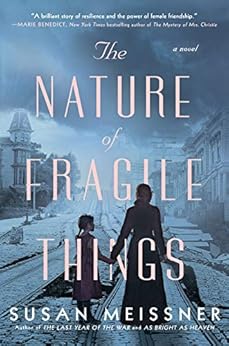
Why This Title: Review and Discussion on The Nature of Fragile Things


About the Book:

Sophie Whalen is a young Irish immigrant so desperate to get out of a New York tenement that she answers a mail-order bride ad and agrees to marry a man she knows nothing about. San Francisco widower Martin Hocking proves to be as aloof as he is mesmerizingly handsome. Sophie quickly develops deep affection for Kat, Martin's silent five-year-old daughter, but Martin's odd behavior leaves her with the uneasy feeling that something about her newfound situation isn't right.

Then one early-spring evening, a stranger at the door sets in motion a transforming chain of events. Sophie discovers hidden ties to two other women. The first, pretty and pregnant, is standing on her doorstep. The second is hundreds of miles away in the American Southwest, grieving the loss of everything she once loved.

The fates of these three women intertwine on the eve of the devastating earthquake, thrusting them onto a perilous journey that will test their resiliency and resolve and, ultimately, their belief that love can overcome fear.
 

My Comments:

It's been a long time since I sat down after work and read a book cover-to-cover in one night (and early morning) but that's exactly what I did last night, and it was time well spent.  
 
Set in San Francisco in the early 1900's, just prior to and just after the great earthquake and fire, the book follows Sophie through the days of her marriage to Martin and through her relationship with Martin's daughter "Kat".  One of my secret vices is trashy Kindle Unlimited romances and a bunch of them are "mail order bride" books--the spunky (or fearful) woman from back east travels across the country to marry a man almost sight unseen and of course before the end of the book they fall in love.  This book is a reminder that the reason many of these women answered those ads was lack of other viable options.  While I'm sure many of those relationships were at least somewhat satisfactory to both parties, I'm also rather sure that some of the men weren't completely honest about their circumstances and that others were abusive in one way or another.  
 
I find the title of the book to be interesting:  The Nature of Fragile Things.  With most books I'm pretty sure how the title relates to the story before I start reading, or, if not then, by the time I'm done.  With this one, I'm pondering.  

What is the nature of fragile things?  Well, they break, that's practically the definition.  Usually if I think of something "fragile" I think of something with some value, even though it is easy to break.  I just googled "fragile" and it means easily broken or damaged, flimsy or unsubstantial, easily destroyed or (of a person) not strong or sturdy, delicate and vulnerable.  So how does the title relate to the book?  

While I'd never call Sophie "fragile", her marriage to Martin certainly was.  We don't consider buildings to be fragile, but the earthquake broke many of them.  Sophie develops a relationship with Kat that is anything but fragile.  Kat's mother has tuberculosis and is very fragile--but also very strong.  Sophie also develops a strong relationship with the woman mentioned above.  
 
Is this a book about being broken?  I don't think so.  Actually I found the women in the book to be strong, despite their circumstances.  The three main adult female characters were all fooled by Martin, so in some ways I suppose he broke all of them, though he didn't end up getting what he wanted from any of these three.  
 
If you read the book, why do you think it has the title it does?  

I'd like to thank the publisher for making a review copy available via NetGalley.  Grade: A


Tuesday, March 05, 2019

Book Review: The Last Year of the War


About the Book:

Elise Sontag is a typical Iowa fourteen-year-old in 1943--aware of the war but distanced from its reach. Then her father, a legal U.S. resident for nearly two decades, is suddenly arrested on suspicion of being a Nazi sympathizer. The family is sent to an internment camp in Texas, where, behind the armed guards and barbed wire, Elise feels stripped of everything beloved and familiar, including her own identity.
The only thing that makes the camp bearable is meeting fellow internee Mariko Inoue, a Japanese-American teen from Los Angeles, whose friendship empowers Elise to believe the life she knew before the war will again be hers. Together in the desert wilderness, Elise and Mariko hold tight the dream of being young American women with a future beyond the fences.
But when the Sontag family is exchanged for American prisoners behind enemy lines in Germany, Elise will face head-on the person the war desires to make of her. In that devastating crucible she must discover if she has the will to rise above prejudice and hatred and re-claim her own destiny, or disappear into the image others have cast upon her.
The Last Year of the War tells a little-known story of World War II with great resonance for our own times and challenges the very notion of who we are when who we’ve always been is called into question.

My Comments

Susan Meissner is one of my must-read authors.  While she writes historical fiction, she usually finds a way to bring the modern day into it.  In this story, Elise, a woman recently diagnosed with Alzheimer's heads to Los Angeles to visit a girlhood friend, before her disease "Agnes" takes her memories completely.  

The story flashes back to the years of WWII and shortly thereafter.  Elise and her family have been deported to an internment camp, where they are kept until arrangements can be made to send them back to Germany, where her parents were born.  While there, she meets a Japanese-American girl, Mariko, from whom she is separated when Elise's family is sent to German in the waning days of WWII.  

Of course the Germany to which they return is a bombed-out shell of the Germany her parents left all those years ago, and the bombing raids at the end of the war destroy even more.  Then comes the occupation, which is not all candy and roses.  Elise never feels at home in Germany and accepts a marriage proposal from a GI--a proposal they both know was made for the sole purpose of getting her back to the US.  We follow her as she returns to a US that is different from the one she left and to a lifestyle that is definitely not what she is used to.  Still, she manages to thrive. 

In some ways this is one of those books where everything just wraps up too neatly.  I liked Elise; she seemed real and ready to take advantage of opportunities presented with out coming across as a selfish person. 

I'd like to thank the publisher for making a review copy available via NetGalley.  Grade: B+

Sunday, April 29, 2018

Review: As Bright As Heaven


About the Book:


In 1918, Philadelphia was a city teeming with promise. Even as its young men went off to fight in the Great War, there were opportunities for a fresh start on its cobblestone streets. Into this bustling town, came Pauline Bright and her husband, filled with hope that they could now give their three daughters--Evelyn, Maggie, and Willa--a chance at a better life.

But just months after they arrive, the Spanish Flu reaches the shores of America. As the pandemic claims more than twelve thousand victims in their adopted city, they find their lives left with a world that looks nothing like the one they knew. But even as they lose loved ones, they take in a baby orphaned by the disease who becomes their single source of hope. Amidst the tragedy and challenges, they learn what they cannot live without--and what they are willing to do about it.

As Bright as Heaven is the compelling story of a mother and her daughters who find themselves in a harsh world not of their making, which will either crush their resolve to survive or purify it.

My Comments:

I like happy feel-good reads, and this isn't one.  Yes, it ends with joy, and hope, and vision of the future, but death is the reason for much of the book, and for that reason it took me a while to read. No, it isn't a difficult read, it's just that my mind is mush and sometimes it takes work to get beyond a romance novel lately.

I've read a lot of books about WWII, but this is one of the few set during WWI that I've read. 1918 was not only the year of WWI, it was also the year of the flu epidemic; both play a role in the story, but the flu in a much more powerful way--and some quick research I did showed that more people died of the flu than from the war.  

What I've always considered to be signature of Susan Meissner's writing is an artifact of some sort linking a character in today's world to a character in the past.  That is lacking in this book; it is pure historical fiction with no modern characters or subplot.  Also, may of Meissner's early books were Christian fiction, though generally on the milder end of the spectrum; this is general market women's fiction.

The story starts with Pauline's youngest child dying and Pauline never completely emotionally recovering from that.  It's funny, we know in our heads that babies died in those days, and that it wasn't uncommon for people we consider young today to die, but how often do we put ourselves in the shoes of those young mothers whose babies didn't survive infancy?  I've "always" known that my mother had an older sister--though I've never thought of her as such--she was nothing to me but a stone in the graveyard.  When I was pregnant with my first child, I threatened to miscarry and at that point I wondered how my grandmother had felt when her baby died.  Years later for some reason my mom told me that my grandmother became depressed when she went through menopause and that my grandfather had asked my mom, who was on her own by that time, to come home for a while to cheer her mom. My mom said that my grandfather mentioned that my grandmother had been like that after they lost the baby, and that he understood that, but couldn't  understand why she was so upset over something that everyone knew would happen at about that age.  

Back to the book, Pauline and her family move to Philadelphia to live/work in a funeral parlor and caring for the dead Pauline begins to heal.  

The story follows the family through the flu epidemic and then the end of WWI and to the beginning of Prohibition. The world was changing, and so was the family.  One of the daughters ends up in medical school and working as a psychiatrist.  

Susan Meissner does a great job of capturing the era, the death, the hope, the change and despite the fact that it isn't all smiles and rainbows, I recommend the book highly.  Grade:  A. 

Thanks to the publisher for providing a review copy via NetGalley. 

Tuesday, December 22, 2015

Review: Stars Over Sunset Boulevard

 
Stars Over Sunset Boulevard

About the Book:


Los Angeles, Present Day. When an iconic hat worn by Scarlett O’Hara in Gone With the Wind  ends up in Christine McAllister’s vintage clothing boutique by mistake, her efforts to return it to its owner take her on a journey more enchanting than any classic movie… 

Los Angeles, 1938.  Violet Mayfield sets out to reinvent herself in Hollywood after her  dream of becoming a wife and mother falls apart, and lands a job on the film-set of Gone With the Wind. There, she meets enigmatic Audrey Duvall, a once-rising film star who is now a fellow secretary. Audrey’s zest for life and their adventures together among Hollywood’s glitterati enthrall Violet…until each woman’s deepest desires collide.  What Audrey and Violet are willing to risk, for themselves and for each other, to ensure their own happy endings will shape their friendship, and their lives, far into the future. 

My Comments:

Those of you who are familiar with Susan Meissner's books know that her "thing" is to take an artifact from a by-gone era and use it to connect a woman of today with a woman from the past.  While often the books tell two stories, the modern day story in this book is brief, and with the relatively short time between the two story threads, there are two women who appear in both stories.  

The story begins in 2012 in a second-hand shop in Los Angeles, but quickly moves to Hollywood in the 1930's.  The stories about the filming of Gone with the Wind were fascinating and showed that Meissner had done her homework.  Still, this isn't a story about filming a movie; it is the story of two young women, their dreams for the future and their relationship with one another and with other people in their lives.  Both Audrey and Violet have felt rejected and are afraid of being rejected again, so they make decisons to protect their hearts, decisions which end up bringing them pain.  Still, they are constants in each others lives over decades.

While many of Meissner's early books were published by Waterbrook, a Christian imprint, and contained mild religious content, this one is published by NAL and is not at all religous.  

I enjoyed Audrey and Violet's story but I found the modern-day sections rather forced and hard to believe.  

I'd like to thank the publisher for providing a review copy via NetGalley.  Grade:  B+

Friday, September 14, 2012

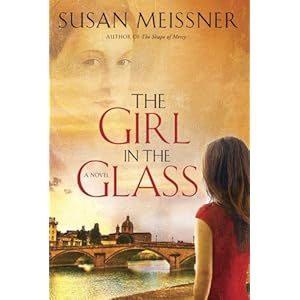
Book Review: The Girl in the Glass


About the Book:

Since she was a child, Meg has dreamed of taking a promised trip to Florence, Italy, and being able to finally step into the place captured in a picture at her grandmother’s house. But after her grandmother passes away and it falls to her less-than-reliable father to take her instead, Meg’s long-anticipated travel plans seem permanently on hold.

When her dad finally tells Meg to book the trip, she prays that the experience will heal the fissures left on her life by her parents’ divorce. But when Meg arrives in Florence, her father is nowhere to be found, leaving aspiring memoir-writer Sophia Borelli to introduce Meg to the rich beauty of the ancient city. Sofia claims to be one of the last surviving members of the Medici family and that a long-ago Medici princess, Nora Orsini, communicates with her from within the great masterpieces of the Italian Renaissance.

When Sophia, Meg, and Nora’s stories intersect, their lives will be indelibly changed as they each answer the question: What if renaissance isn’t just a word? What if that’s what happens when you dare to believe that what is isn’t what has to be?

My Comments:

I absolutely loved this book! I loved the story, the characters, the writing, even the cover.  Like Susan Meissner's other books, The Girl in the Glass unites the stories of a modern-day woman and a woman from history.  In this case the woman from history was a woman from the Medici family who lived during the Italian Renaissance.  The women from today are an American book editor and an Italian tour guide/author.  

Meg's parents divorced when she was young and her mother moved her away from her beloved Grandmother, who happened to be from Florence, Italy.  Her grandmother promised to one day take her to Florence, and when she dies before she can fulfill this promise, her father adopts the promise.  Meg is now in her early thirties and keeps waiting for the trip.  One day her father sends her tickets and off she goes to join him in Florence.  When he doesn't show up and tells her he isn't going to, she goes to plan B and meets up with some authors she knows through work.  

Sofia says she is the last of the Medicis and that she can hear Nora, who lived long ago, speak to her.  Sofia has written a travelogue giving voice to Nora, and Meg is interested in publishing it.  However, the more she learns about Sofia, the less sure she becomes.  In short, things aren't as they seem, either in her life, or in the life of Nora, and interestingly they have paralles with Meg's life.

The chapters set today are preceded by short sections "written by Nora".  The typeface is different so it is easy to keep the stories separate.  

While the book is classified as Christian fiction, I'm not sure why.  While there are a few references to God or faith, they aren't central to the book.  

I'd like to thank the publisher for sending me a review copy as part of their Blogging for Books program.  As anyone who has read the blog for any length of time knows, the opinions I post about books, even those given to me by publishers, are my own.  In this case my own opinion is that this book deserves an A.  

Sunday, September 19, 2010

Lady in Waiting: My Review

Lady in Waiting: A Novel

It is said that those who do not know history are doomed to repeat it.  While I'm sure there is some truth to the statement, I have to wonder how much of history we are doomed to repeat simply because of our humanity?  While our fashions, governments and customs change through the years, the basics of humanity remain very much the same.  

Susan Meissner's books, including Lady in Waiting: A Novel link the past and the present through some artifact.  In this case, the artifact is a ring found in an old book.  It has the name "Jane" engraved inside it, and "Jane" is the lady who found it.  The modern-day Jane lives in Manhattan.  Her son just left for college and her husband just left her, saying they needed a break from each other to decide what they wanted in the future.  She is a woman who has always been a pleaser, making the choices she made because others wanted her to make them.  The historical Jane is Lady Jane Grey who ruled as Queen of England for 9 days.  Her story is told by her seamstress, Lucy.  Jane's path it seems is directed by others, primarily her parents, and her life is ended by an executioner--but at the end she has a choice to make, and revels in being able to make it.

I'm sometimes leery about reading books classified as Christian fiction if they are set during the Reformation.  All too often the Catholic Church ends up being the villain, the awful group trying to keep the truth from the masses.  Since I had read and enjoyed Meissner's books in the past, I decided to give this one a try, and I'm glad I did. 

 For those not familiar with Tudor England, Henry VIII (the guy with all the wives) broke from Rome and established the Church of England.  He left three children when he died:  Edward, who was raised Protestant; Mary who was raised Catholic and Elizabeth who was raised Protestant.  When he died, Edward became king, but was still a boy.  Edward died before he married.  The powers behind the throne did not want a Catholic ruler, so they got Edward to write a will passing the throne to his cousin, Jane, a Protestant.  Mary's supporters rallied and she was able to take power.  She had Jane and her supporters convicted of treason and executed.  Wikipedia calls Jane a Protestant martyr and the book states that Mary sent her confessor to try to obtain Jane's conversion (though whether it would have made any difference in her lifespan will never be known).  

While Lady in Waiting: A Novel talks about Jane writing to the Reformers on the Continent, the content of those letters is not discussed; religious references in the book are few and if the publisher wasn't a publisher of Christian fiction, I'd classify the book as historical fiction, not Christian fiction.  Though it mentions Jane being a Protestant and refusing to convert to Catholicism when Mary tried to get her to do so, I'd never know what either faith was about by reading this book.  In a lot of ways, this book confirms my personal opinion that the Reformation, for most people, particularly in England, was a lot more about politics than about religion. 

In short though, this is a wonderful novel that tells the story of two women who lived hundreds of years apart; two women whose lives seemed to be directed by other others; two women who realize that they can make choices.  It is well-written and is a title I'd recommend to those who say they don't like Christian fiction.

View My Stats